EazyDI

The Evolution of Data Integration and the Rise of AI-Driven Vibe Coding

Data integration has come a long way. What began decades ago with tightly coupled, code-heavy approaches has evolved into a modern ecosystem driven by flexibility, openness, and increasingly, artificial intelligence.

In the early days, data integration was dominated by low-level programming languages such as COBOL. Logic was hard-coded, brittle, and deeply embedded within systems. As relational databases gained adoption, SQL became the backbone of data movement and transformation,
enabling more standardized access to data but still requiring significant manual effort and specialized expertise.

As organizations matured and data volumes grew, integration practices evolved again. Python emerged as a powerful language for data engineering, offering flexibility, readability, and access to a rich open-source ecosystem. At the same time, enterprise integration platforms entered the market, promising to abstract complexity away from developers. These tools shifted teams from writing large amounts of custom code to using drag-and-drop components and point-and-click interfaces. The goal was productivity and consistency, especially at enterprise scale.

That evolution did not stop there. Over time, organizations realized that performance and scalability could be improved by pushing transformations closer to the data. This led to a broader adoption of ELT patterns, where data is first loaded into cloud data warehouses or lakehouses, and transformations are executed directly within those environments. Pushdown processing became the norm, reducing data movement and leveraging the power of modern cloud platforms.

Now, the industry is entering its next major shift.

The Rise of Vibe Coding and AI-Assisted Development

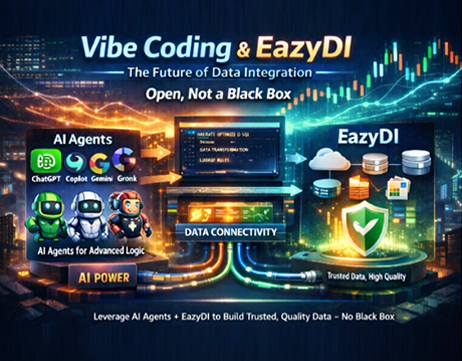
One of the most significant changes we are seeing today is the rise of what many are calling vibe coding. This refers to the use of AI assistants such as ChatGPT, Copilot, Gemini, Grok, and others to help write, optimize, and reason about code. Data-driven organizations are increasingly
leveraging these tools to accelerate development, reduce repetitive work, and tackle complex transformation logic more efficiently.

Vibe coding is not just about speed. It is also about openness. For years, many organizations gravitated toward open-source technologies because they valued transparency, flexibility, and control. However, open source often comes with tradeoffs, particularly around security,governance, enterprise support, and operational maturity. As a result, organizations have constantly had to balance openness with enterprise-grade requirements.

AI-assisted coding is helping bridge that gap. Teams can now move faster while still working in familiar languages like SQL and Python, retaining visibility into their logic and avoiding unnecessary abstraction. This is especially appealing to organizations that want to remain agile
without being boxed into rigid, proprietary frameworks.
Where Traditional Integration Platforms Fall Short

Despite these trends, many enterprise integration platforms remain hesitant to fully embrace this new reality. While they may claim to be partner-friendly or support pushdown transformations, they often still require users to perform transformations within their own tooling. In practice, this creates a black box. The logic lives inside the platform, portability is limited, and organizations become increasingly locked into a single vendor.
What many users want today is different. They want freedom to leverage AI-generated SQL and Python. They want to own their transformation logic. They want the ability to evolve their architecture without being constrained by proprietary transformation engines.

How EazyDI Embraces the Future

At EazyDI, we are not running away from vibe coding. We are embracing it.
We recognize that this is where the industry is heading, and more importantly, where modern data teams want to go. Instead of forcing customers into a closed ecosystem, EazyDI is designed to work alongside AI-assisted development. We focus on what matters most: fast, reliable connectivity between data sources and targets, enterprise-grade orchestration, and trusted data foundations.
Our philosophy is simple. Use vibe coding and AI agents where they add the most value, such as complex transformation logic, optimization, and experimentation. Let EazyDI handle the heavy lifting around ingestion, connectivity, scheduling, monitoring, and governance. This approach avoids vendor lock-in while still delivering enterprise-level capabilities.

Why Data Quality and Trust Matter More Than Ever

One critical area that is often overlooked in this new wave of tools is data trust. Many emerging solutions focus heavily on speed and connectivity but neglect data quality altogether. As organizations increasingly rely on AI and autonomous agents, this becomes a serious risk.
AI systems are only as good as the data they consume. Without proper data profiling, validation, and quality controls, results can be misleading, biased, or flat-out wrong. Poor data quality does not just impact dashboards. It directly affects downstream analytics, machine learning models, and automated decision-making.
EazyDI addresses this head-on. In addition to enabling vibe coding and open transformation approaches, we embed data quality and profiling capabilities directly into the integration process. This ensures that data is not only fast and accessible, but also trusted, governed, and ready for AI consumption.

The Next Generation of Data Integration

As data integration continues to evolve, the future is clear. Organizations want openness, flexibility, and speed, without sacrificing trust, security, or enterprise readiness. Vibe coding and AI-assisted development are becoming core parts of modern data workflows, not fringe experiments.
For organizations moving in this direction and looking for a platform that supports AI-driven development while maintaining strong data quality foundations, EazyDI represents the next generation of data integration. We believe the future is not a black box. It is open, transparent, and built on trusted data. If that vision aligns with where your organization is heading, then you are already thinking like the next generation of data-driven teams.