
Data integration has come a long way. What began decades ago with tightly coupled, code-heavy approaches has evolved into a modern ecosystem driven by flexibility, openness, and increasingly, artificial intelligence.
In the early days, data integration was dominated by low-level programming languages such as COBOL. Logic was hard-coded, brittle, and deeply embedded within systems. As relational databases gained adoption, SQL became the backbone of data movement and transformation,
enabling more standardized access to data but still requiring significant manual effort and specialized expertise.
As organizations matured and data volumes grew, integration practices evolved again. Python emerged as a powerful language for data engineering, offering flexibility, readability, and access to a rich open-source ecosystem. At the same time, enterprise integration platforms entered the market, promising to abstract complexity away from developers. These tools shifted teams from writing large amounts of custom code to using drag-and-drop components and point-and-click interfaces. The goal was productivity and consistency, especially at enterprise scale.
That evolution did not stop there. Over time, organizations realized that performance and scalability could be improved by pushing transformations closer to the data. This led to a broader adoption of ELT patterns, where data is first loaded into cloud data warehouses or lakehouses, and transformations are executed directly within those environments. Pushdown processing became the norm, reducing data movement and leveraging the power of modern cloud platforms.
Now, the industry is entering its next major shift.
The Rise of Vibe Coding and AI-Assisted Development
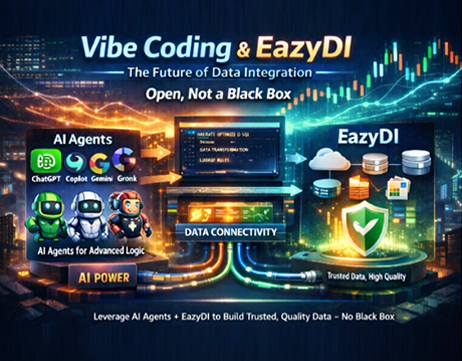
One of the most significant changes we are seeing today is the rise of what many are calling vibe coding. This refers to the use of AI assistants such as ChatGPT, Copilot, Gemini, Grok, and others to help write, optimize, and reason about code. Data-driven organizations are increasingly
leveraging these tools to accelerate development, reduce repetitive work, and tackle complex transformation logic more efficiently.
Vibe coding is not just about speed. It is also about openness. For years, many organizations gravitated toward open-source technologies because they valued transparency, flexibility, and control. However, open source often comes with tradeoffs, particularly around security,governance, enterprise support, and operational maturity. As a result, organizations have constantly had to balance openness with enterprise-grade requirements.
AI-assisted coding is helping bridge that gap. Teams can now move faster while still working in familiar languages like SQL and Python, retaining visibility into their logic and avoiding unnecessary abstraction. This is especially appealing to organizations that want to remain agile
without being boxed into rigid, proprietary frameworks.