
Data integration has become the backbone of digital transformation. As
organizations adopt cloud platforms, realtime analytics, and distributed architectures,
the need for flexible, scalable, and intelligent integration tools has never been
greater. Three platforms frequently evaluated in this space are Informatica
PowerCenter, Informatica Intelligent Data Management Cloud (IDMC), and
EazyDI.
While Informatica has long been a leader in enterprise data integration, modern
cloudnative platforms like EazyDI are redefining what seamless, scalable, and
automated integration should look like. This post focuses exclusively on integration
capabilities—how each platform connects, transforms, and orchestrates data
across systems.
1. Informatica PowerCenter: Traditional ETL Built for the OnPrem Era
Informatica PowerCenter has been a foundational ETL tool for decades. Its
architecture is built around centralized, onpremises processing and batchoriented
data movement.
Integration Strengths
- Mature ETL engine for structured data
- Strong connectivity to traditional databases and enterprise systems
- Metadatadriven design for reusable mappings
- Reliable for scheduled, batchbased workflows
Integration Limitations
- Not cloudnative; requires significant infrastructure management
- Limited realtime integration without addons
- Slow development cycles due to legacy tooling
- High maintenance overhead for scaling, upgrades, and monitoring
PowerCenter remains powerful, but its architecture reflects a precloud world.
1. Informatica PowerCenter: Traditional ETL Built for the OnPrem Era
Informatica PowerCenter has been a foundational ETL tool for decades. Its
architecture is built around centralized, onpremises processing and batchoriented
data movement.
Integration Strengths
- Mature ETL engine for structured data
- Strong connectivity to traditional databases and enterprise systems
- Metadatadriven design for reusable mappings
- Reliable for scheduled, batchbased workflows
Integration Limitations
- Not cloudnative; requires significant infrastructure management
- Limited realtime integration without addons
- Slow development cycles due to legacy tooling
- High maintenance overhead for scaling, upgrades, and monitoring
PowerCenter remains powerful, but its architecture reflects a precloud world.
2. Informatica IDMC: CloudEnabled, Modular Integration
Informatica IDMC modernizes the PowerCenter ecosystem by offering a cloudnative
integration platform with broader capabilities.
Integration Strengths
- Cloudnative iPaaS supporting ETL, ELT, API integration, and streaming
- AIassisted development via CLAIRE
- Large connector library for SaaS and cloud platforms
- Elastic scaling for highvolume workloads
- Realtime and eventdriven integration options
Integration Limitations
- Complexity remains high due to multiple modules (CDI, CAI, API Manager, etc.)
- Licensing can become expensive as workloads grow
- Migration from PowerCenter can be lengthy and costly
- Requires specialized skills to manage and optimize
IDMC is a major step forward, but its ecosystem can feel fragmented and costly to
operate.
3. EazyDI: A Unified, CloudNative Integration Platform Built for Modern Data
EazyDI is a cloudbased ELT/ETL platform designed for scalable, secure, and
seamless data integration. It simplifies complex workflows with an intuitive
interface, powerful automation, and a unified architecture that eliminates the
fragmentation seen in legacy tools.
Integration Strengths
- Cloudnative architecture built for elasticity and performance
- 200+ connectors for cloud apps, databases, SaaS platforms, and onprem systems
- API integration for custom workflows and servicetoservice communication
- Transformation Wizard for quick, lightweight data changes
- SQLbased transformations via postload scripting for advanced ELT
- Seamless connectivity with Snowflake, BigQuery, Redshift, Azure SQL, and more
- Data quality & validation with builtin checks
- Automation & scheduling for time or eventbased triggers
- Rolebased access control for enterprisegrade security
- Unified monitoring with realtime pipeline visibility
EazyDI is designed for teams that want speed, simplicity, and intelligence without the
operational burden of traditional ETL platforms.
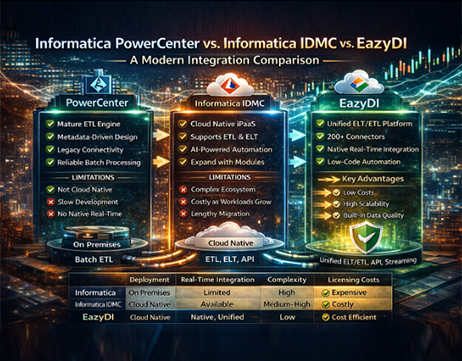
SidebySide Integration Comparison
| Capability | Informatica PowerCenter | Informatica IDMC | EazyDI |
|---|---|---|---|
| Deployment | Onpremises | Cloudnative | Cloudnative |
| Integration Types | Batch ETL | ETL, ELT, API, streaming | ETL, ELT, API, streaming, orchestration |
| RealTime Integration | Limited | Available | Native & unified |
| Connector Coverage | Strong for legacy | Broad for cloud & SaaS | Broad + optimized for modern SaaS |
| Automation | Minimal | Moderate | High (smart automation) |
| Complexity | High | Medium–High | Low |
| Scalability | Hardwaredependent | Elastic | Elastic + autooptimized |
| Cost Efficiency | Low | Medium | High |
Why Traditional ETL Tools Fall Short Today
Legacy ETL platforms—especially those not built for the cloud—struggle with
modern data demands:
- Limited Scalability
Not designed for cloud elasticity or big data workloads.
- High Maintenance Overhead
Require specialized skills and constant manual intervention.
- Slow Development Cycles
Rigid architectures slow down pipeline changes and deployments.
- Poor Cloud Integration
Limited support for platforms like Snowflake, BigQuery, and modern SaaS
apps.
- Higher Cost of Ownership
Expensive licensing, infrastructure, and operational costs.
- Reduced Agility
Hard to adapt to realtime data needs and evolving business requirements.
Why EazyDI’s Integration Capabilities Outperform Informatica
EazyDI isn’t just a modern alternative—it’s a fundamentally different approach to
integration.
- 1. Unified Integration Without Fragmentation
Informatica requires multiple modules for ETL, ELT, APIs, and streaming.
EazyDI delivers all of this in one unified platform, reducing complexity and cost.
- 2. Faster Development with Automation + LowCode
EazyDI accelerates integration through:
- Automated mapping
- Transformation wizards
- High Performance Processing
This leads to shorter development cycles and faster timetovalue.
- 3. CloudNative from Day One
Unlike PowerCenter (onprem) and IDMC (cloudadapted), EazyDI is born in the
cloud, offering:
- Zero Infrastructure Management
You don’t need to install servers, manage hardware, patch systems, or
maintain environments. EazyDI handles all compute, storage, scaling, and
platform operations behind the scenes. Teams can focus entirely on building
pipelines instead of managing infrastructure.
- Continuous Updates Without Downtime
EazyDI automatically delivers new features, performance improvements, and
security enhancements without interrupting your workflows. There are no
upgrade windows, no version conflicts, and no maintenance outages — the
platform stays up‑to‑date on its own.
- A Secure Hybrid Agent
For organizations with on‑premises systems, EazyDI provides a secure agent
that runs inside your network. It enables encrypted, outbound‑only
connectivity to your internal databases, applications, and file systems —
without opening firewall ports or exposing internal systems. This allows you to
integrate cloud and on‑prem data seamlessly while maintaining strict security
controls.
- 4. RealTime Integration as a Core Feature
EazyDI treats batch, realtime, and eventdriven integration equally—no extra modules
required.
- 5. Lower Total Cost of Ownership
EazyDI reduces:
- Licensing complexity
- Infrastructure costs
- Development effort
- Maintenance overhead
Conclusion
Informatica PowerCenter and IDMC remain strong players in the integration
landscape, but they carry the weight of legacy architectures and complex
ecosystems. EazyDI, by contrast, offers a modern, unified, cloudnative
integration platform that simplifies development, accelerates delivery, and reduces
operational burden.
For organizations seeking speed, scalability, automation, and lower cost, EazyDI
clearly delivers integration advantages that surpass both PowerCenter and IDMC.